Labiaplasty — Inner Labia Reshaping

Sensation-preserving, natural-looking labiaplasty.

A doctor-led, discreet consultation in Istanbul. We talk plainly about trim vs. wedge techniques, who the operation actually suits, and what recovery really looks like.

Op. Dr. Berra Önsoy — Consultant Obstetrician & Gynaecologist
Medically written & reviewed by
Op. Dr. Berra Önsoy · Consultant Obstetrician & Gynaecologist
Istanbul, Turkey · 29 years of clinical practice · 6 min read · Consults in English & Turkish

Istanbul University Cerrahpaşa (English) MD, 1997. Ob-Gyn residency at Taksim Training & Research Hospital (2001). Private practice in Istanbul focused on endometriosis, myoma surgery, high-risk pregnancy and aesthetic gynaecology.

Clinical focus
  • Endometriosis surgery
  • Myoma (fibroid) surgery
  • High-risk pregnancy
  • Aesthetic gynaecology
  • HPV & colposcopy
Last medically reviewed: 15 January 2026View full clinical credentials·Verify on:drberraonsoy.cominstagram.com

Labiaplasty at a glance

  • What it is: surgical reshaping of the inner labia (labia minora) to relieve friction, correct asymmetry, and — if the patient chooses — refine appearance.
  • How long: 45–90 minutes, local + sedation or general anaesthesia, same-day discharge.
  • Techniques: trim (edge), wedge (V-resection), or hybrid — chosen for anatomy, not preference.
  • Recovery: desk work in 7–10 days, sport at 4 weeks, intercourse and swimming at 6 weeks, final result at 3–6 months.
  • Sensation: clitoral nerves lie outside the operative field — sensitivity is preserved.
  • Who does it: Op. Dr. Berra Önsoy — obstetrician & gynaecologist, MD 1997, specialty 2001, ~30 years' experience, JCI-accredited Istanbul hospitals.

What is labiaplasty?

Labiaplasty is a functional-aesthetic gynaecological procedure that reshapes the inner labia (labia minora). It aims to relieve physical discomfort with clothing, sport or intimacy, ease hygiene, and — if the patient chooses — improve symmetry.

Op. Dr. Berra Önsoy uses a conservative surgical philosophy: clitoral sensation and natural edge tissue are preserved and tissue is never over-resected. There is no single "correct shape" — the plan is built around your anatomy and personal goals.
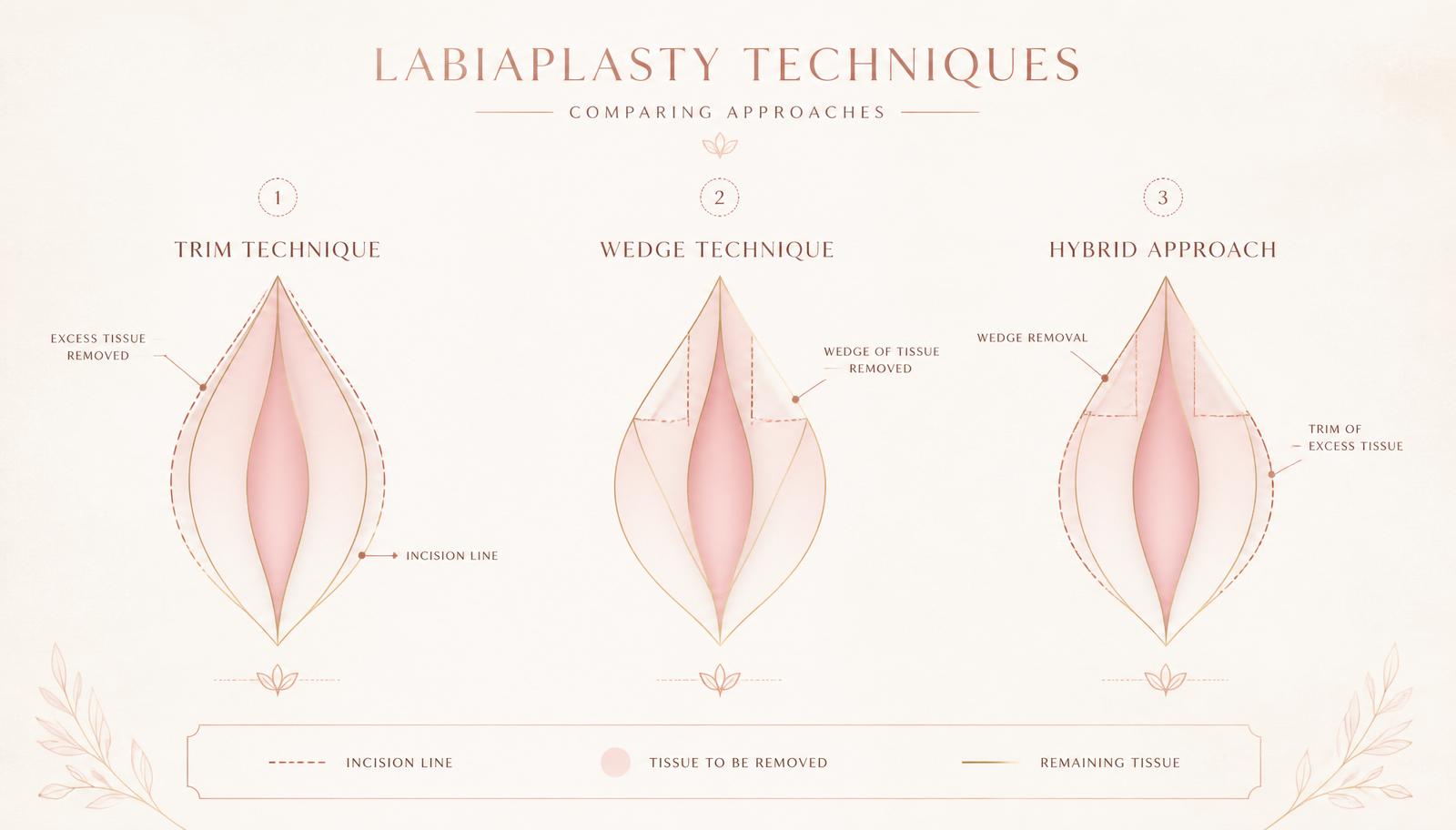
Techniques — Trim vs. Wedge vs. Hybrid

Schematic comparison of trim, wedge and hybrid labiaplasty techniques with incision lines
Educational illustration — schematic comparison of the three main labiaplasty techniques. Not a photograph.

Trim (edge) technique

The darker, excess edge of the inner labia is removed directly. A clean, predictable result — very effective for correcting asymmetry.

Best for: Marked edge excess, darker or irregular edges.

Wedge (V) technique

A V-shaped section is removed from the middle of the labia so the natural wavy edge is preserved — a more 'untouched' look.

Best for: Patients who want to keep natural edge colour and texture.

Hybrid approach

Trim combined with clitoral hood reduction, or trim + wedge in one session. Restores overall balance in a single operation.

Best for: Combined anatomical needs; excess clitoral hood alongside labial excess.

Technique is a matter of suitability, not preference. In consultation we look at your anatomy, goals and lifestyle together and explain why a specific technique is right for you.

Who might it suit?

  • • Friction or irritation from clothing, tight trousers or underwear
  • • Pain during cycling, running, yoga or horse riding
  • • Physical discomfort during intercourse
  • • Asymmetry after childbirth, hormonal change or ageing
  • • Hygiene difficulty or recurrent urinary / genital irritation
  • • A personal aesthetic concern raised freely, without external pressure
Ethical note. Labiaplasty is not recommended to "correct" normal anatomical variation. Sometimes the right answer in consultation is to not operate — and we will tell you so.

Day-by-day recovery

  1. Day 0
    Surgery day — 45–90 min procedure, same-day discharge.
  2. Day 1–2
    Swelling and bruising peak. Ice and rest, lying down rather than sitting.
  3. Day 3–7
    Discomfort fades quickly. Warm water hygiene, loose cotton underwear.
  4. Day 7–10
    Return to desk work, gentle walking, driving.
  5. Week 3–4
    Most swelling resolves. Gradual return to exercise (running, light weights).
  6. Week 6
    Intercourse, swimming, sea and full sport.
  7. Month 3–6
    Tissue fully softens, suture line fades, final result visible.

Risks and realistic expectations

In the right hands and for the right indication labiaplasty is safe, but — like any surgical procedure — it has specific risks that we discuss honestly in consultation.

  • • Swelling, bruising and transient discomfort (first 2 weeks)
  • • Rare wound-edge separation — minimised by rest and hygiene
  • • Minor asymmetry (correctable with a small revision)
  • • Over-resection dryness — minimised by a conservative technique

Frequently asked questions

When is labiaplasty appropriate?
When there is genuine physical discomfort (friction, irritation, pain during sport or intercourse), recurrent hygiene difficulty, or a personal aesthetic concern raised by the patient herself — not because someone else suggested it.
Trim vs. wedge — which technique is right?
The trim technique removes the excess edge directly and gives a very predictable result but changes the natural edge. The wedge technique removes a V-shaped section, preserving the natural edge colour and texture. Choice depends on anatomy and personal goals — decided together in consultation.
Will I lose sensitivity?
A correctly planned labiaplasty preserves clitoral sensitivity because the clitoris and its nerve branches lie outside the operative field. Local sensation returns to normal within a few weeks.
How long does the surgery take? Do I stay overnight?
The procedure takes 45–90 minutes and is usually day-case — you go home the same day. International patients are advised to stay 5–7 days in Istanbul.
What is recovery like?
Swelling and mild bruising peak in the first 48 hours and settle with ice and prescribed pain relief. Most patients return to desk work in 7–10 days. Sutures are dissolvable.
When can I return to sport and intimacy?
Gentle walking from week 1, running and weights from week 4, cycling / swimming / intercourse from week 6.
Will there be scars?
Incisions are placed within natural folds and become almost invisible over time. Early scar care and sun protection help.
Can I still give birth vaginally afterwards?
Yes. Labiaplasty does not affect the ability to have a normal vaginal delivery.
How much does labiaplasty cost?
Cost depends on the technique (trim only, wedge, combined with clitoral hood reduction), anaesthesia type and hospital setting. A transparent quote is shared after online or in-person consultation.
How does the process work for international patients?
A free online video consultation reviews history and (optional) photos. If suitable, a 5–7 day plan in Istanbul is arranged: pre-op review, surgery, two follow-ups and online aftercare once you're home.
Labiaplasty vs vaginoplasty — what is the difference?
Labiaplasty reshapes the external inner labia (labia minora). Vaginoplasty tightens the vaginal canal and pelvic floor muscles from the inside. They address different concerns and can be combined when both external and internal changes are present.
How much does labiaplasty cost in Istanbul compared to the UK?
Labiaplasty in a JCI-accredited Istanbul hospital typically costs 50–70% less than an equivalent private procedure in London — including surgeon, anaesthetist, hospital fees and follow-up. A transparent, all-inclusive quote is shared after consultation.
Is labiaplasty covered by the NHS or private insurance?
The NHS covers labiaplasty only in rare, strictly documented functional cases. Most private UK insurers exclude it as cosmetic. International patients therefore usually self-fund — one reason Istanbul is a well-established destination for the procedure.
Is there a minimum or maximum age?
Labiaplasty is not performed under 18. There is no strict upper limit — postmenopausal patients in good general health are routinely operated. Fitness for surgery, not age, is the deciding factor.
Can I use tampons or a menstrual cup after labiaplasty?
Sanitary pads only for the first 4 weeks. Tampons and menstrual cups can usually be reintroduced from week 4–6, once the suture line has fully healed.

Let's start with a conversation

On a free online video consultation Op. Dr. Berra Önsoy will assess your situation, explain which technique might suit you — or whether surgery is needed at all.